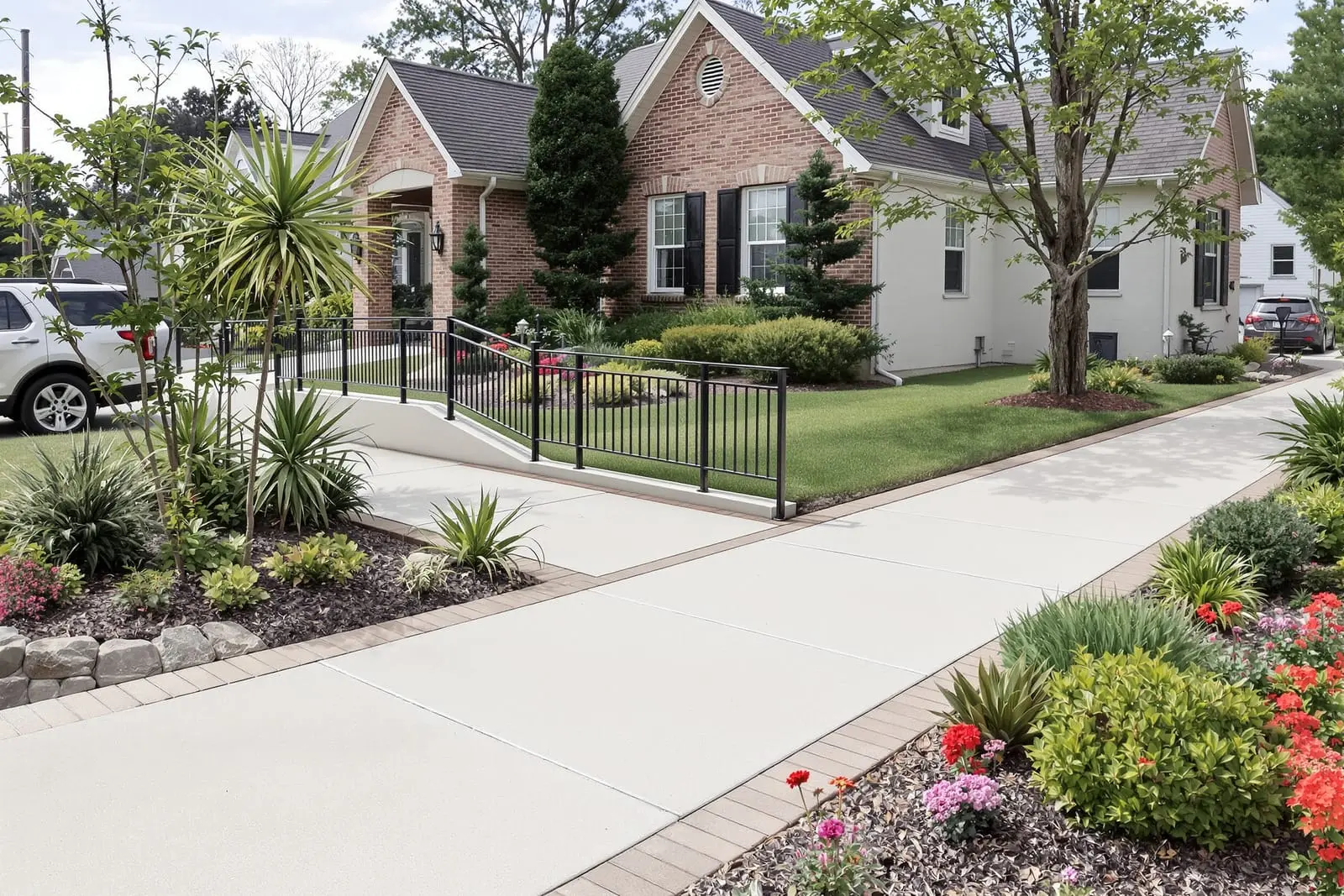
Primetime Concrete Pasadena performs commercial sidewalk installation in Pasadena, TX with a focus on accessibility and code compliance. We construct ADA ramps, landings, and walks with proper slopes, handrail locations, and detectable warnings. Our concrete surfaces provide safe paths from parking to entrances for all visitors. Upgrade your access routes to meet current standards and improve usability.
Primetime Concrete Pasadena provides professional commercial sidewalk installation throughout Pasadena, TX and the surrounding area. Our licensed, insured crew delivers safe, clean, on-time work with a free estimate before anything begins. Call (346) 584-6090 or request your free quote.
Commercial sidewalks that work hard in Pasadena, TX
Commercial sidewalk installation in Pasadena, TX is not just about pouring concrete and walking away. At Primetime Concrete Pasadena, we look at how your sidewalks will really be used: employee foot traffic at shift change, customers parking and cutting across the lot, deliveries at side doors, and students or families if you are near schools or churches.
During our initial walk-through, we measure widths, slopes, and tie-in points to your existing pavement or building entries. We look for low areas where water already sits after a rain, tree roots that could lift a slab, and traffic patterns that might require thicker concrete or reinforcing steel. For most commercial sidewalks we recommend at least 4 inches of 3000 to 3500 PSI concrete, and often 5 inches in front of busy entries or where carts and small vehicles roll.
We also talk about finish options that make sense locally. In Pasadena, smooth finishes get slick when algae grows in our humid weather, so we usually suggest a light broom finish for better traction. For higher end storefronts, we can use decorative broom patterns, scored joints, or exposed aggregate in targeted areas while still keeping the main walking surface ADA friendly and slip resistant.
Every project includes a joint layout plan. Control joints are cut or tooled to help manage cracking from our heat swings and occasional cold snaps. We space them based on slab thickness and panel size so when the concrete moves, it cracks in a straight, controlled line instead of randomly across the middle of your new walk. That level of planning makes a visible difference after the first summer on your property.
How we install commercial sidewalks step by step
Once you approve a plan with Primetime Concrete Pasadena, we schedule work around your business hours to keep customers moving. For retail and restaurants along Spencer Highway, Red Bluff, or Fairmont Parkway, we often stage work in sections so your main entrance always has a safe path.
Step 1 is layout and excavation. We mark the new sidewalk path, call 811 for utility locates, then remove grass, old concrete, or failed asphalt down to stable soil. In parts of Pasadena with softer or fill soils, especially near bayous or drainage channels, we may over-excavate and add a compacted crushed concrete or limestone base to keep the sidewalk from settling.
Step 2 is forming and base prep. We install sturdy wood or steel forms to the correct elevation and side slopes so water drains to landscaping or designated inlets, not toward your building. Base material is spread and compacted in layers with a plate compactor or roller. If specs or site conditions call for it, we add welded wire mesh or rebar to reinforce the slab, especially near dumpster pads, loading areas, or drive lanes.
Step 3 is concrete placement. We typically use ready-mix from local plants with a mix design suited for our climate, including air entrainment when needed. Concrete is poured, spread, and leveled with screeds, then bull floated to bring up paste and fill small voids. We set surface slope according to drainage and ADA guidelines, then apply a uniform broom finish for grip.
Step 4 is jointing, edging, and curing. We tool edges to reduce chipping and cut control joints at the proper spacing and depth, usually within the first day. We apply a curing compound or use wet curing techniques to reduce early-age cracking from our sun and wind. Finally, we remove forms, backfill edges, and if needed, add caution tape and cones so pedestrians avoid the area until the slab reaches initial strength.
ADA ramps that actually pass inspections
ADA compliant ramps are a big part of commercial sidewalk installation in Pasadena. City inspectors and accessibility consultants are paying more attention now, especially on remodels where existing entries do not meet current guidelines.
When Primetime Concrete Pasadena designs an ADA ramp, we start with precise measurements instead of guessing. Using digital levels, we check existing door thresholds, parking lot elevations, and any transitions to city sidewalks. The goal is to keep slopes within the 1:12 guideline where required, manage cross slope, and reduce the need for handrails unless your site layout clearly needs them.
Common local issues include old parking lots that have settled near the building, leaving a larger rise than the original design. In those cases we may extend the ramp run, add intermediate landings, or coordinate with an asphalt contractor to adjust pavement grades. For corner ramps that tie into city sidewalks, we match City of Pasadena details as closely as possible so you do not get flagged during certificate-of-occupancy or resale inspections.
We install detectable warning panels (truncated domes) at the ends of ramps where pedestrians enter vehicle areas. These can be cast-in-place or surface applied, typically in yellow for visibility. We set them into freshly placed concrete or mechanically fasten them to cured slabs, making sure there are no trip edges. All edges around the ramp are finished smoothly to reduce chipping from shopping carts, dollies, and daily traffic.
Before we pour any ADA ramp, we do a dry run with strings and levels, then again after forming, to confirm compliance. After the concrete cures, we recheck slopes so you have documentation if a landlord, corporate office, or inspector asks how the ramp was built.
What drives cost and how to plan your budget
Business owners in Pasadena usually want to know why one commercial sidewalk installation bid is higher than another. At Primetime Concrete Pasadena we are upfront about what affects cost so you can compare apples to apples.
The largest drivers are square footage, concrete thickness, and base preparation. Sidewalks over soft or wet soil near Sims Bayou or Vince Bayou often need thicker base material or geotextile fabric to keep from sinking, which adds material and equipment time. Ramps and transition areas usually take more labor than flat walks because of extra forming and slope checks.
Access plays a role too. If we can back a truck right up to the work area, your price is lower than a job that requires wheelbarrow runs or a concrete buggy across an active site. Working overnight or in tight time windows, such as busy convenience stores or medical offices, can slightly increase cost because we bring extra crew members to finish on time.
Finish choices and reinforcement matter as well. Standard broom finish with fiber-reinforced concrete is the most cost effective. Thicker sections with rebar grids, decorative scoring, or colored concrete will cost more but might be justified at key entrances or high visibility plazas. We will separate “must have” ADA and safety items from “nice to have” upgrades so you can decide where to invest.
We always include sawcut joints, curing, and haul-off of broken concrete in our pricing. If a quote you receive seems significantly cheaper, ask whether those items are included, whether base material is compacted or just dumped, and what PSI mix is being used. A sidewalk that looks fine on day one but cracks and settles in two summers of Pasadena heat is never really the cheapest option.
Common issues in Pasadena and how we prevent them
Our climate and soil create specific problems for commercial sidewalks and ADA ramps in Pasadena, and we plan for them from the start.
Frequent heavy rains followed by heat mean drainage is critical. If sidewalks are set too flat or pitched wrong, water ponds, algae grows, and surfaces become slick. Primetime Concrete Pasadena always checks where downspouts, roof drains, and landscape grades send water. We set slopes to move water off the walk and away from the building while still staying within ADA limits near ramps and entries.
Expansive or loose soils are another concern, especially on properties that have been filled and regraded. Without proper compaction and base, slabs can settle and create trip hazards at joints. We compact subgrade in thin lifts and often use crushed concrete base reclaimed from local projects to create a stable platform. Where trees are close, we try to route sidewalks outside major root zones, or we build thicker slabs with proper joints so minor movement does not break the surface.
Thermal movement from hot Gulf Coast summers to the occasional winter cold front leads to cracking if joint spacing and depth are wrong. Our crews follow jointing practices that match slab thickness and panel size, and we often sawcut joints in the evening of the pour or early the next morning to catch them before uncontrolled cracks form.
Finally, we think about how the space will operate after we leave. On busy sites, we coordinate with you so customers have safe temporary routes, clear signage, and no surprises. We provide simple maintenance tips, like how soon you can use de-icing products if needed, how to clean stains without damaging the surface, and what to watch for in the first year. When you call Primetime Concrete Pasadena, you get commercial sidewalks and ADA ramps built for real Pasadena conditions, not a generic one-size-fits-all template.
“
Professional commercial sidewalks & ada ramps, done right the first time, quality materials, honest pricing, and results that last.
Primetime Concrete Pasadena
Commercial Sidewalks & ADA Ramps Across Our Service Area